It will surprise you to know that there are about 940 species of bird in Nigeria, which are classified as ENDEMIC and ACCIDENTAL.
According to checklist of Birds of the World, Accidental birds are not endemic to Nigeria they just happen to be found here! And amazingly way more than the endemic ones!
Endemic birds are therefore, birds specifically found in Nigeria, and they are grouped into FOUR namely:
THE IBADAN MALIMBE
The
Ibadan malimbe (
Malimbus ibadanensis) is a rare species of Bird.
It is
endemic to
Nigeria,
where it is known only from the southwestern part of the country. It
was first discovered in 1951 and was common at one point, but forest
clearing made it rare.
Identification
The bird is about 20 centimeters long. The male is black with a red
head and breast. The female has smaller red areas.
The bird forages in
pairs or small groups, sometimes alongside the
red-headed malimbe (
Malimbus rubricollis).
Habitat
It lives in forest and woodland habitat, including degraded areas.
 THE ANAMBRA WAXBILL
The
Anambra waxbill (
Estrilda poliopareia) is another specie of bird found in wetter land of southern
Nigeria.
Identification
The anambra waxbill is approximately 12cm long. This species of a dun-coloured finch with reddish brown bill and rump. If looked at closely, it has very fine barring on it upper parts, sides of breast and flanks, with unusual pal eyes. It has a typical waxbill-like tzzt... call.
Habitat
The Anambra waxbill lives in small flocks of up to 20 birds or more. It appears to be found at southern
Nigeria,
and is known with certainty from only five reported sightings. It is
usually found in long grass along rivers, lagoon sandbanks, marshes,
swamps and forest. It feeds principally on grass seeds taken from
seedheads.
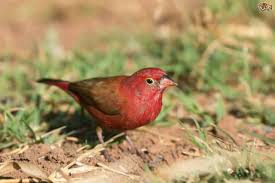
ROCK FIREFINCH
The
Rock firefinch (
Lagonosticta sanguinodorsalis) is another specie found in northern
Nigeria. It has an estimated global extent of occurrence of 29,000 km². The status of the species is evaluated as
Least Concern.
Identification
The Rock firefinch has a blue-grey bill, red back in the male and
reddish brown back in the female and juvenile and broad primaries in
both the adult and juvenile.

Location
It is commonly found in bushy and rocky outcrops on the
Jos Plateau. It probably feeds on grass seeds. Yea, think i remember this particular bird while in Jos!!!!
JOS PLATEAU INDIGOBIRD
The
Jos Plateau indigobird (
Vidua maryae) is a species of
bird in the
Viduidae family. Also endemic to
Nigeria.
It lays its eggs in the nest of the
rock firefinch
which is also restricted to Nigeria. Because of their inability to
incubate their eggs, they lay their eggs in the nest of the rock
firefinch and then take away the exact number of laid eggs from the host
bird in order to avoid suspicion from the host bird . After hatching
they exhibit dominance against the hatchlings of the rock firefinchers.
Their breeding seasons are all round the year but more pronounced during
the cold
Harmattan period between July and December.
Habitat
Its natural
habitats are dry
woodland and
shrubland in rocky areas. It is threatened by
habitat loss.
|
|---|
|
|---|
| If you want to know and learn more about the Accidental Birds, keep a date!!! |
|
|---|
|
|
|
|
|
|
|
|
|
|
|
|
|
|
|
|
|
|
|


